From Christchurch to Milford Sound: A Journey through New Zealand’s Most Spectacular Landscapes
If you were to draw a line from Christchurch down through the heart of the South Island and out to the edge of Fiordland, you’d trace what might be the most scenically intense road journey in the Southern Hemisphere. It’s a route that moves through half a dozen distinct worlds — Canterbury plains, alpine passes, braided river valleys, glacial lakes, ancient rainforest — before arriving at one of the most profound places on earth.
Milford Sound is, quite simply, one of those destinations that humbles you. The scale is difficult to comprehend from a photograph. You need to be there — standing at the water’s edge, looking up at Mitre Peak rising sheer from the fiord, listening to the thunder of waterfalls that run for hundreds of metres down vertical cliff faces — to begin to understand what you’re looking at.
But the journey there matters just as much as the destination. This is why how you travel to Milford Sound shapes the experience entirely.
The Road through the Southern Alps
Leaving Christchurch heading south, the Canterbury Plains open up in every direction — flat, golden, and vast in a way that feels uniquely New Zealand. The Southern Alps sit on the horizon like a wall, and as you move closer, they grow in that slightly disorienting way that only happens with truly large mountains.
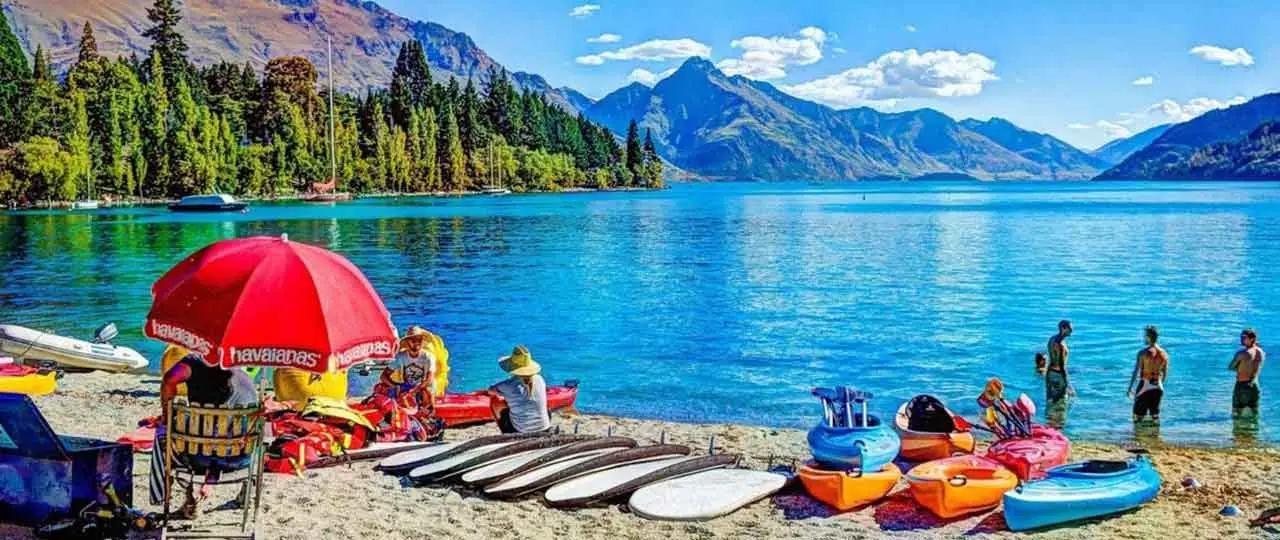
The alpine corridor through to Queenstown takes you past Lake Tekapo, where the turquoise water against the brown tussock and snowy peaks is one of those sights that genuinely doesn’t look real. Then Mt Cook — Aoraki — comes into view. At 3,724 metres, it dominates everything around it. Stopping here, even briefly, is non-negotiable.
Queenstown sits at the other end of this stretch, nestled around Lake Wakatipu. It’s lively and cosmopolitan by New Zealand standards, and makes an ideal overnight base before the final push into Fiordland.
Into Fiordland — Where New Zealand Gets Serious
The drive from Queenstown to Milford Sound is around four hours through Te Anau and into Fiordland National Park. It’s worth starting early, partly because the morning light in the fiord is extraordinary, and partly because the road itself — the Milford Road — demands your full attention. It’s one of the most beautiful drives on the planet. Ancient beech forest lines both sides. Waterfalls appear from nowhere. The Homer Tunnel, hand-hewn through solid rock over a decade of difficult work, drops you suddenly into the Cleddau Valley on the other side of the divide.
What you won’t get on a private tour is the anxiety of a group schedule. You stop at Mirror Lakes when the conditions are right. You take the time at the Chasm to properly understand what you’re seeing — rock sculpted by water over millennia. You don’t rush. Fiordland insists that you don’t rush.
Milford Sound: Worth Every Kilometre
The fiord itself is best explored by boat, gliding beneath the cliffsides with dolphins occasionally appearing off the bow. The scale shifts constantly — up close, the rock faces are covered in thousands of tiny waterfalls and clinging ferns; step back, and everything dwarfs you entirely. On overcast days, clouds curl around the peaks and waterfalls multiply. On clear days, the reflections in the black water are almost painfully beautiful.
Rudyard Kipling once called Milford Sound the eighth wonder of the world. It’s a quote that gets repeated so often it risks losing meaning. Being there restores it entirely.
Making the Journey Your Own
The Christchurch-to-Milford corridor is best suited to a multi-day journey — three to five days allows you to move through it without feeling like you’re simply ticking off landmarks. Our seven, ten, and fourteen-day South Island experiences are built around exactly this philosophy: give the landscape the time it deserves, and it gives back in kind.
Private touring means you’re not locked into predetermined stops or group dynamics. You travel with a knowledgeable local guide, in a comfortable vehicle, on a schedule that bends to your interests rather than the other way around. For a journey of this magnitude, there really is no other sensible approach.